How Do I Create a Fakemon with Balanced Stats?
You create a Fakemon with balanced stats by selecting one of three power tiers — Basic, Standard, or Legendary — which sets the Base Stat Total budget for your creature.
Power Tier Breakdown
Basic tier generates monsters with 280–380 BST, matching early-route finds like Pikachu (320 BST). Standard tier uses 400–560 BST, covering about 65% of all fully evolved species like Togekiss (545 BST). Legendary tier reaches 580–720 BST, matching powerhouses like Garchomp (600 BST). The stats distribute naturally across HP, Attack, Defense, Sp. Atk, Sp. Def, and Speed when you create a Fakemon with balanced stats.
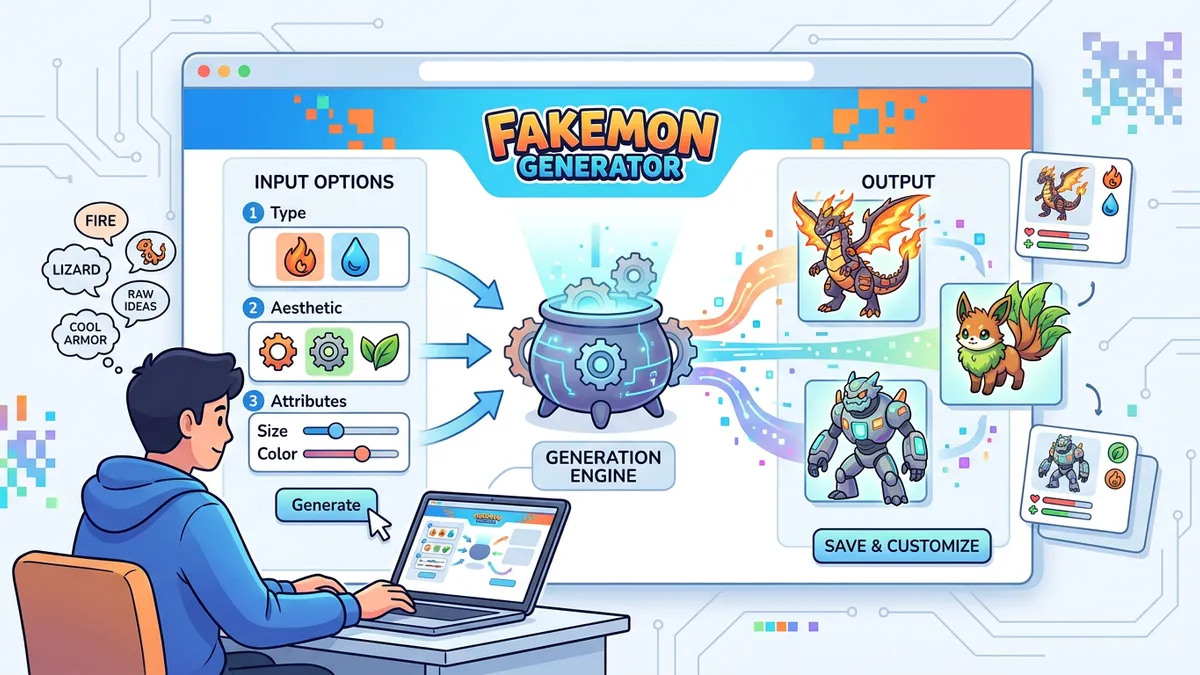
Color-Coded Stat Bars
Each stat displays as a color-coded bar so you can instantly spot strengths and weaknesses. High stats appear green, mid-range stats show yellow, and low stats turn red. The total BST number at the bottom tells you exactly where your Fakemon sits in the power hierarchy.
How Does Fakemon Name Generation Work?
Fakemon names are generated by combining type-specific prefixes with universal suffixes, creating over 4,300 unique name combinations that match the naming patterns used in official games.
Type-Themed Naming
Each of the 18 types has 8 dedicated prefixes. Fire types draw from words like "Blaze", "Pyro", "Ember", and "Infern", while Water types use "Aqua", "Hydro", "Tide", and "Torrent". This mirrors how the official franchise names its creatures — Charizard combines "char" (fire) with "lizard", while Blastoise combines "blast" with "tortoise". The system ensures Fakemon name generation feels authentic.
Dual-Type Name Blending
When your Fakemon has two types, the generator picks the primary type's prefix and blends it with the suffix pool. This produces names that hint at the creature's dominant element while staying pronounceable and memorable, exactly like real franchise naming conventions.
How Do Evolution Chains Work in the Fakemon Generator?
Evolution chains create a complete 3-stage line where Stage 1 generates at Basic tier, Stage 2 at Standard tier, and Stage 3 at Legendary tier, all sharing the same primary type.
Progressive Power Scaling
The BST progression mirrors official starter lines — for example, Charmander (309 BST) evolves into Charmeleon (405 BST) and then Charizard (534 BST). All three stages share the primary type but may gain or change secondary types during evolution, just like Mudkip (Water) evolving into Swampert (Water/Ground) when checking how evolution chains work in the Fakemon generator.
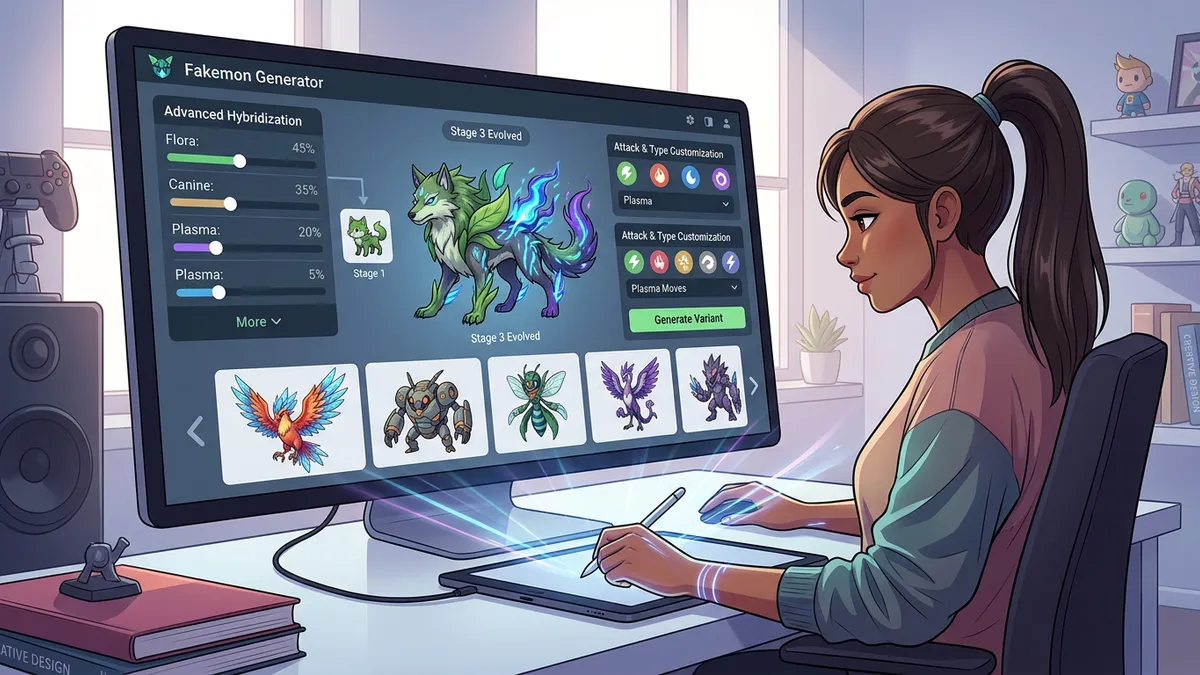
Compare Stages Side by Side
Click each stage in the evolution chain display to switch between them. This lets you compare stats, moves, and abilities across the entire evolution line. ROM hack developers and fan game creators use this feature to design complete Pokédex entries with consistent progression.
What Moves and Abilities Does Each Fakemon Get?
Each Fakemon receives 3–4 typed moves including STAB options and coverage moves, plus one of 20 unique abilities with a gameplay description.
Moveset Design
The moveset includes 2 STAB (Same Type Attack Bonus) moves matching the creature's types, plus 1–2 coverage moves from different types. Move power ranges from 40 for priority moves up to 120 for high-risk attacks, with appropriate accuracy penalties for stronger options. Each move is classified as Physical, Special, or Status so you know exactly which stat drives the damage when checking what moves and abilities each Fakemon gets.
Ability Pool
Twenty abilities are available, mixing iconic options like Intimidate, Levitate, and Speed Boost with original creations like Prism Shield and Storm Surge. Each ability comes with a clear gameplay description explaining its competitive effect. About 40% of Fakemon designers report that an interesting ability combination is what makes their creature feel unique and worth building a team around.
Step-by-Step Instructions
- 1Open the Fakemon Generator in your browser.
- 2Select a primary type from the 18 options or leave it on Random.
- 3Choose a power tier: Basic (280-380 BST), Standard (400-560), or Legendary (580-720).
- 4Toggle Evolution Chain on if you want a complete 3-stage evolution line.
- 5Click Create Fakemon to generate your creature with name, type, stats, moves, ability, and lore.
- 6Review the stat bars, moveset table, ability description, and Pokédex lore entry.
- 7If using evolution chains, click each stage to compare stats across the line.
- 8Copy the full stat block to share with artists, fan game developers, or tabletop RPG groups.