How Do I Generate a Random DnD Character?
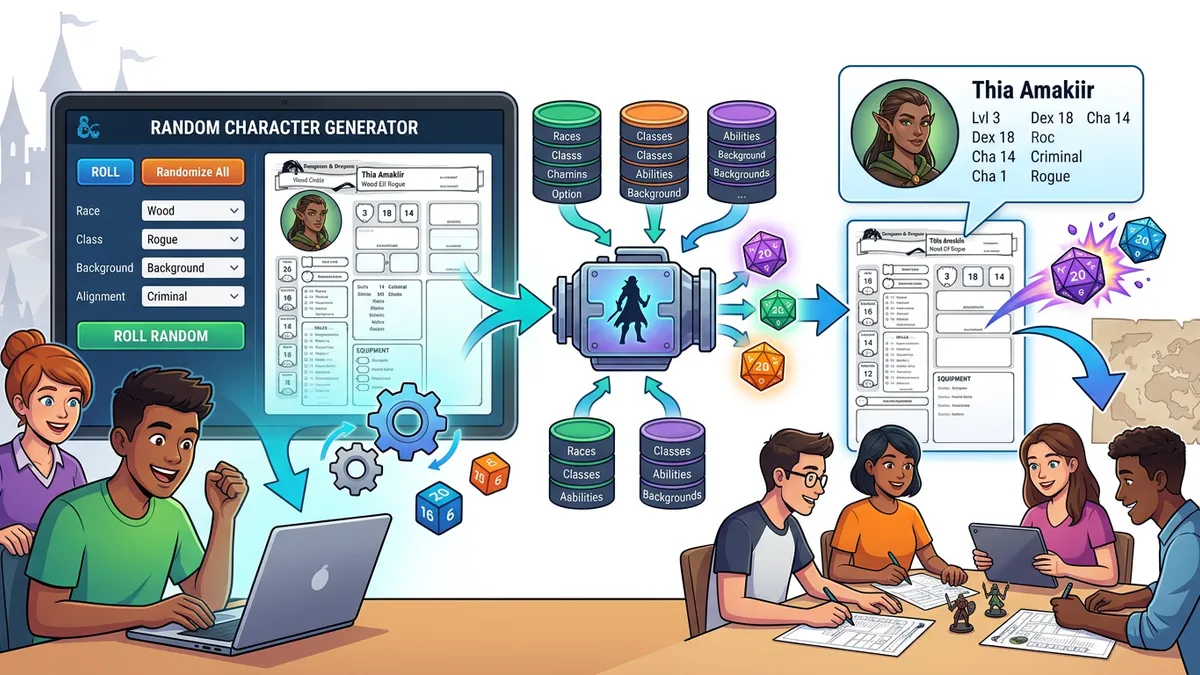
You generate a random DnD character by selecting a level, choosing your stat generation method, and clicking Roll Character — the tool handles all the math and produces a complete playable sheet.
Race and Class Options
The generator includes 16 playable races (Human, Elf, Dwarf, Halfling, Tiefling, Dragonborn, Half-Orc, Goliath, Tabaxi, Kenku, and more) and 13 classes (Fighter, Wizard, Rogue, Barbarian, Paladin, and all others including Artificer). Each race applies its official ability score bonuses automatically — Half-Orcs get +2 STR/+1 CON, Tieflings get +2 CHA/+1 INT when you generate a random DnD character.
Level and Stat Method
Set your character level from 1 to 20. Proficiency bonus scales automatically from +2 at level 1 to +6 at level 17+. Choose between 4d6 drop lowest (classic rolling with visible dice), Standard Array (15/14/13/12/10/8), or Point Buy (27 points, scores capped at 15 before racial bonuses).
How is HP and AC Calculated in DnD 5e?
HP is calculated using the maximum hit die value at level 1 plus your Constitution modifier, then the average hit die plus Constitution modifier for each additional level.
Hit Points Formula
Each class has a different hit die: Barbarians use d12 (average 7), Fighters use d10 (average 6), Rogues use d8 (average 5), and Wizards use d6 (average 4). A level 5 Barbarian with +3 CON gets 12+3 at level 1, then 4×(7+3) for levels 2–5, totaling 55 HP. The generator runs this formula automatically for every race-class-level combination to show exactly how HP and AC are calculated in DnD 5e.
Armor Class Computation
AC depends on class armor proficiency. Heavy armor classes like Fighters and Paladins use the armor's base AC. Barbarians calculate 10 + DEX mod + CON mod through Unarmored Defense. Monks use 10 + DEX mod + WIS mod. The generator selects the appropriate formula for each class.
What Stat Generation Method Should I Use?
The stat generation method you should use depends on whether you want randomness (4d6 drop lowest), guaranteed balance (Standard Array), or controlled customization (Point Buy).
4d6 Drop Lowest
The classic method rolls four dice and drops the lowest. This produces scores from 3 to 18 with an average of about 12.24. There's only a 1.6% chance of rolling an 18. The generator shows all four dice with the dropped one visually crossed out so you can verify the roll. About 58% of players prefer this method for the excitement of randomness when deciding what stat generation method to use.
Standard Array and Point Buy
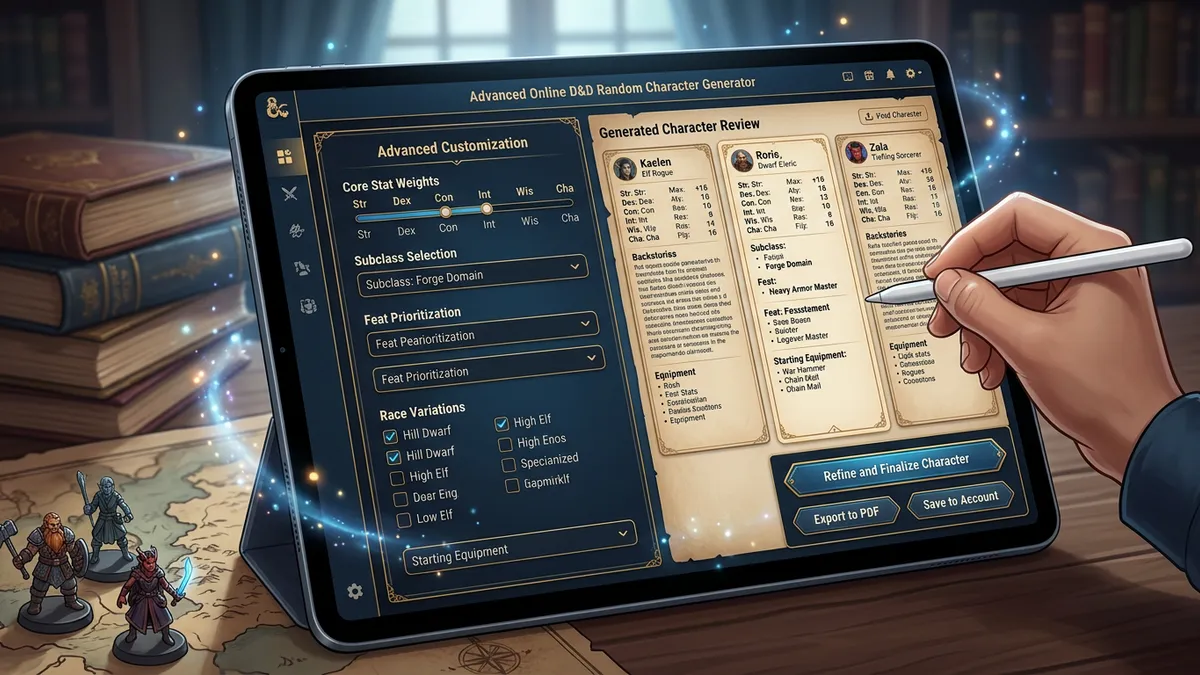
Standard Array assigns 15/14/13/12/10/8 to your six stats — perfectly balanced with a total of 72 across all scores. Point Buy gives you 27 points to spend, with increasing costs for higher scores, capping individual stats at 15 before racial bonuses. Both methods are recommended for organized play where fairness matters.
Can I Use This for One-Shots and Backup Characters?
You can use this generator for one-shots and backup characters by generating complete sheets in seconds instead of spending 30-60 minutes on manual character creation.
One-Shot Sessions
One-shots are self-contained 3–5 hour D&D sessions where players need disposable characters fast. About 68% of DMs run at least one one-shot per month. Generate a character, copy the sheet, and start playing immediately — no Player's Handbook flipping required when you want to use this for one-shots and backup characters.
Backup Characters and NPC Creation
In lethal campaigns, having a backup character ready prevents session disruption when a PC dies. The history feature stores your 8 most recent characters for quick access. DMs also use the generator for NPC stat blocks — a level 5 Human Fighter makes a convincing guard captain, while a level 12 Tiefling Warlock works as a villain's lieutenant.
Step-by-Step Instructions
- 1Open the DnD Random Character Generator in your browser.
- 2Select a level from 1 to 20.
- 3Optionally lock a specific race or class, or leave both on Random.
- 4Choose your stat generation method: 4d6 Drop Lowest, Standard Array, or Point Buy.
- 5Click Roll Character to generate a complete 5e character.
- 6Review the character sheet: combat stats, ability scores, proficiencies, features, and personality traits.
- 7Copy the full character sheet with one click to paste into session notes or virtual tabletops.