How Does Encounter Balancing Work in 5e?
Encounter balancing in 5e works by comparing the total XP value of all monsters in the fight against the party's XP threshold for their desired difficulty level.
XP Thresholds by Level
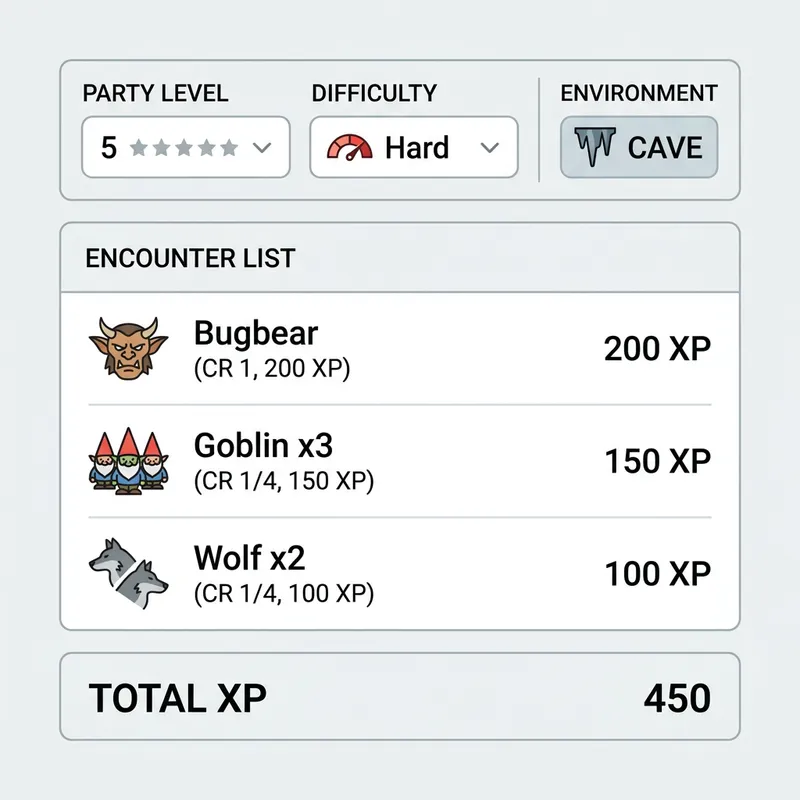
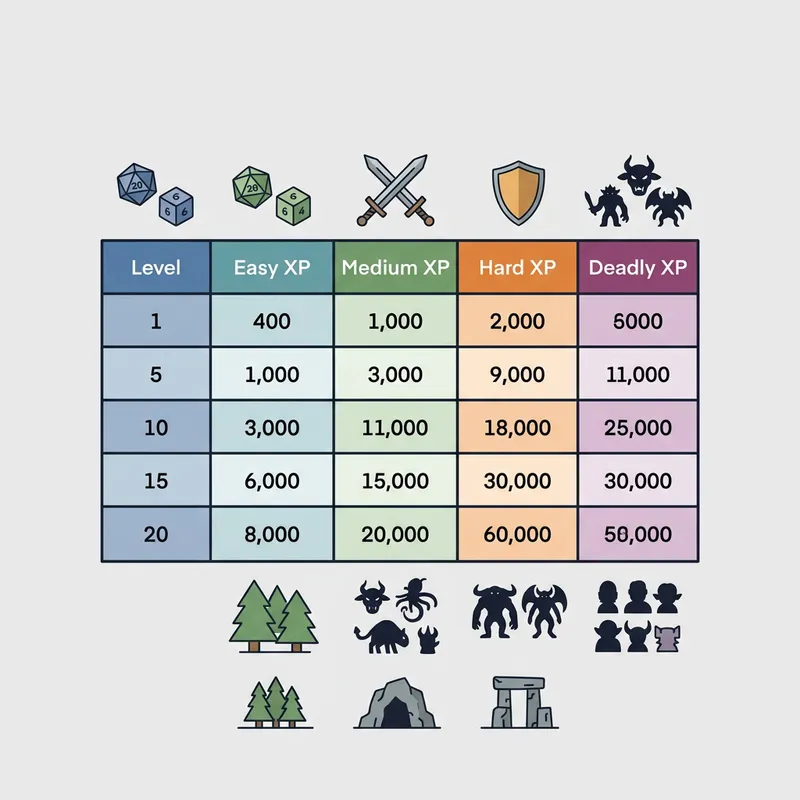
The Dungeon Master's Guide defines 4 XP thresholds per party level: Easy, Medium, Hard, and Deadly. A level 5 party of 4 players has thresholds of 1,000 XP (Easy), 2,000 XP (Medium), 3,000 XP (Hard), and 4,400 XP (Deadly). The generator automatically calculates these thresholds based on your party level and fills the budget with appropriate monster groups when checking how encounter balancing works in 5e.
Monster Multiplier Rules
Multiple monsters multiply the encounter's effective XP. Two monsters multiply the total by 1.5×, and 7+ monsters multiply by 2.5×. This means 4 goblins worth 200 XP total actually count as 400 XP effective difficulty. The generator accounts for these multipliers automatically.
What is the Best Difficulty for My Party?
The best difficulty for your party depends on how many encounters you plan per long rest — most campaigns run 2 to 4 medium encounters per adventuring day.
Difficulty Tier Guidelines
Easy encounters drain minimal resources and serve as warm-ups. Medium encounters challenge the party without serious risk of death. Hard encounters push the party and may cause a character to drop to 0 HP. Deadly encounters can cause multiple character deaths if the dice go badly. About 72% of DMs report running mostly Medium and Hard encounters to find the best difficulty for their party.
Resource Management
The adventuring day assumes 6–8 medium encounters between long rests. If you only run 2–3 encounters per day, bump the difficulty up to Hard or Deadly to compensate. Otherwise your spellcasters will never feel resource pressure and combat becomes trivial.
How Do Challenge Ratings Work in DnD?
Challenge Rating (CR) represents the approximate difficulty a single monster presents to a party of 4 adventurers at that level — a CR 5 monster is a fair fight for a level 5 party.
CR to XP Conversion
Each CR has a fixed XP value. CR 1 is worth 200 XP, CR 5 is worth 1,800 XP, CR 10 is worth 5,900 XP, and CR 20 is worth 25,000 XP. The generator displays these values per monster so you can see exactly how the XP budget breaks down when learning how challenge ratings work in DnD.
Monster Diversity
The generator includes 24 classic D&D monsters spanning CR 1/4 (Goblins, Kobolds) to CR 8+ (Hydras, Young Dragons). This covers the most commonly used creatures from the Monster Manual and gives you a solid foundation for encounters at any party level.
Can I Customize the Encounter Environment?
The generator randomly assigns one of 8 encounter environments — Dungeon, Forest, Cave, Swamp, Mountain, Desert, Ruins, and Underwater — to each generated encounter.
Environment and Monster Pairing
Different environments create different tactical dynamics. A Cave encounter with tight corridors limits area-of-effect spells. A Forest encounter provides natural cover and line-of-sight blockers. A Swamp encounter can include difficult terrain that slows melee fighters. Pair the environment with monster tactics to customize the encounter environment for maximum dramatic impact.
Combining with Narrative Encounters
Use this tool alongside the DnD Encounter Generator for a complete session prep workflow. The narrative generator provides the story hook and complication, while this 5e generator handles the XP-balanced monster selection. Together they give you both the "why" and the "what" of every combat encounter.
Step-by-Step Instructions
- 1Open the 5e Encounter Generator in your browser.
- 2Set your party level from 1 to 20.
- 3Choose the desired difficulty: Easy, Medium, Hard, or Deadly.
- 4Click generate to build an XP-balanced encounter.
- 5Review the monster list with names, CR ratings, types, and individual XP values.
- 6Check the total XP and environment assignment.
- 7Adjust difficulty or regenerate until you find the right challenge level.
- 8Copy the encounter details for your session notes.