How Do You Calculate Interest on a CD?
You multiply your deposit by a compound interest formula — but you don't need to remember it. The calculator does it for you.
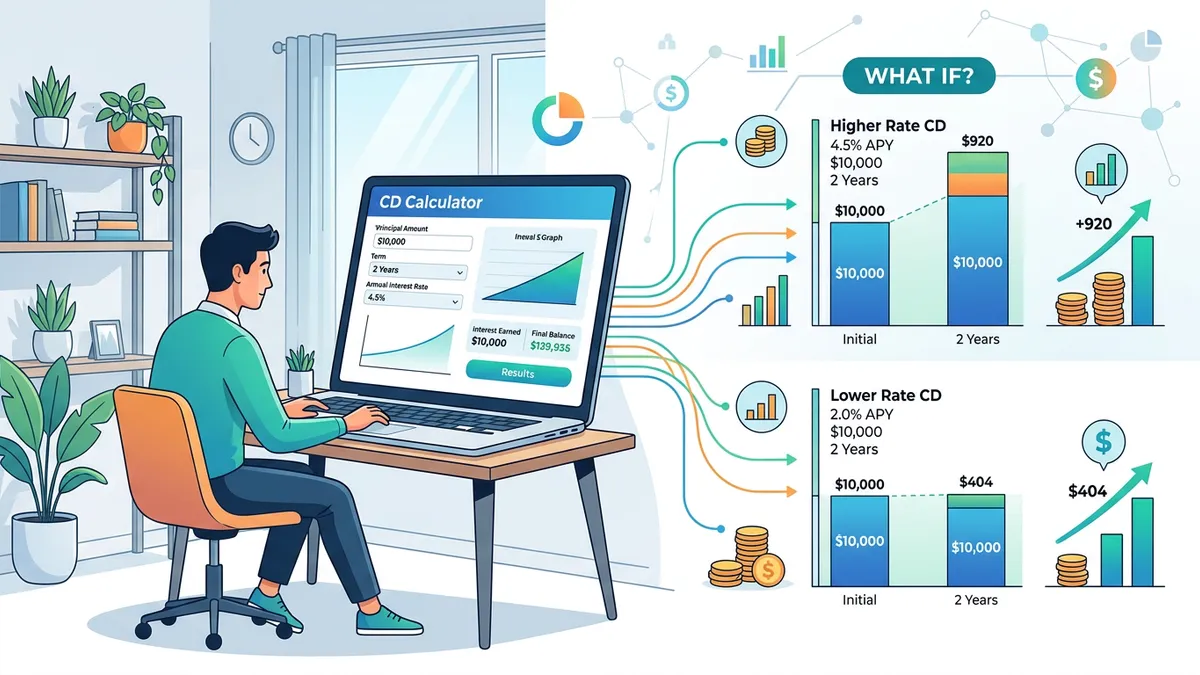
Here's the short version: a CD pays you interest on your original deposit plus any interest that's already accumulated. That's compound interest. A $10,000 deposit at 4.50% APY for 2 years with monthly compounding grows to $10,934.43. The same deposit with daily compounding? $10,941.83 — about $7 more.
The difference between daily and monthly compounding is small on one CD. But across a $50,000 deposit over 5 years, it adds up to real money.
For the formula-curious, here's the math the calculator runs under the hood:
- P = your initial deposit ($10,000 in the example above)
- r = the annual interest rate as a decimal (4.50% → 0.045)
- n = how often interest compounds per year (365 for daily, 12 for monthly)
- t = the term in years (2 years, or 1.5 for an 18-month CD)
You don't need to memorize this. Just know that more frequent compounding = slightly more interest. Daily beats monthly beats quarterly beats annual. The calculator lets you compare all four side by side.
What's the Difference Between APY and Interest Rate on a CD?
APY is the number that actually matters. The base interest rate ignores compounding. APY includes it.
Banks advertise both, and they look almost identical on short-term CDs. On a 1-year CD at 4.00% with daily compounding, the base rate is 4.00% but the APY is 4.08%. That 0.08% gap doesn't sound like much — until you run the numbers on larger deposits.
Here's what a $50,000 deposit earns in one year at the same 4.00% base rate, depending on compounding:
| Compounding | Effective APY | Interest Earned | Extra vs. Annual |
|---|---|---|---|
| Annual | 4.00% | $2,000.00 | — |
| Quarterly | 4.06% | $2,030.15 | +$30.15 |
| Monthly | 4.07% | $2,037.07 | +$37.07 |
| Daily | 4.08% | $2,040.53 | +$40.53 |
The takeaway: when comparing CD offers from different banks, always compare APY to APY. A bank quoting a 4.10% base rate with annual compounding is actually worse than one quoting 4.00% with daily compounding.
Most online banks — Ally, Marcus, Discover — compound daily. Traditional brick-and-mortar banks often compound monthly or quarterly. This calculator shows you the actual difference in dollars.
How Much Does It Cost to Withdraw from a CD Early?
Usually between 90 and 365 days of interest, depending on your CD's term length.
CDs lock your money for a fixed period. Break that agreement early, and the bank charges a penalty. Here's what most banks charge (according to FDIC published penalty guidelines):
- CDs under 12 months — 90 days of interest
- 12 to 36 months — 150 to 180 days of interest
- 36 to 60 months — 270 to 365 days of interest
Here's why this matters: if you withdraw from a 12-month CD just 3 months in, you've only earned 3 months of interest but you owe 6 months. That means the penalty eats into your original deposit. You'd literally walk away with less money than you put in.
Our early withdrawal penalty estimator lets you plug in your bank's specific penalty rules to see exactly what you'd lose. It's worth running the numbers before you open a CD, not after you need the cash.
If there's any chance you'll need the money, consider a no-penalty CD or a shorter term. The rate will be lower, but you won't get hit with fees.
What Is a CD Ladder and Is It Worth It?
A CD ladder splits your money across multiple CDs with staggered terms so you get regular access to your cash without giving up long-term rates.
Say you have $25,000 to park. Instead of locking all of it into one 5-year CD, you split it into five chunks:
- $5,000 in a 1-year CD
- $5,000 in a 2-year CD
- $5,000 in a 3-year CD
- $5,000 in a 4-year CD
- $5,000 in a 5-year CD
Every year, one CD matures. You either use the money or roll it into a new 5-year CD. After 5 years, you have a 5-year CD maturing every single year. You get the best of both worlds: long-term rates and annual liquidity.
This strategy works especially well when rates are high and you want to lock them in before they drop. The Federal Reserve cut rates three times in late 2024, and most banks adjusted their CD rates downward within weeks.
Our CD ladder builder models this exact scenario. It shows you the total interest across all rungs, the maturity schedule, and what each CD earns individually.

Should I Put My Money in a CD or a Savings Account?
If you won't touch the money for 6+ months, a CD almost always pays more. If you might need it next week, stick with savings.
As of mid-2025, the best high-yield savings accounts (Ally, Marcus, SoFi) pay around 4.00–4.25% APY with no lock-in. The best 1-year CDs pay 4.50–5.00% APY. That 0.50% gap earns you an extra $50 per year on a $10,000 deposit.
But CDs have one big tradeoff: your money is locked. With a savings account, you can transfer funds out any time. With a CD, early withdrawal costs you 3–6 months of interest.
The real question is: how sure are you that you won't need this money? If the answer is "very sure," the CD wins. If there's any doubt, the savings account's flexibility is worth the slightly lower rate.
For emergency funds, use a savings account. For money you're saving toward a specific goal 1–5 years out — a down payment, a wedding, a new car — CDs make more sense.
Step-by-Step Instructions
- 1Enter your deposit amount — the cash you plan to put into the CD.
- 2Set the interest rate (APR) and pick a compounding frequency: daily, monthly, quarterly, or annual.
- 3Choose your CD term in months or years.
- 4Check the results: total interest earned, final maturity balance, and effective APY.
- 5Optional: toggle early withdrawal penalty or tax impact to see how those change your net return.