Aging Test Calculator

Estimate accelerated product aging.

CalculatorsFreeNo Signup
4.6(247 reviews)
All Tools

This tool is coming soon! Check back later.

About Aging Test Calculator

Calculate accelerated aging test duration using the Arrhenius equation (Q10 factor).

Aging Test Calculator Features

  • Q10 factor calculation
  • Real vs accelerated time conversion
Accelerated aging testing is essential for validating the shelf life of medical devices, pharmaceuticals, and packaged goods without waiting years for real-time results. The Aging Test Calculator uses the Arrhenius equation with a Q10 aging factor to convert between real-time shelf life and accelerated test duration at elevated temperatures. Enter your desired shelf life, storage temperature, and test temperature to instantly calculate how long your accelerated aging study should run.

How to Use the Aging Test Calculator

Design your accelerated aging study in seconds:

Enter target shelf life. Specify how many months or years of real-time aging you want to simulate.

Set your temperatures. Enter the ambient (real-world storage) temperature and the elevated (accelerated test) temperature in degrees Celsius. Common test temperatures are 55°C and 60°C for products stored at room temperature (25°C).

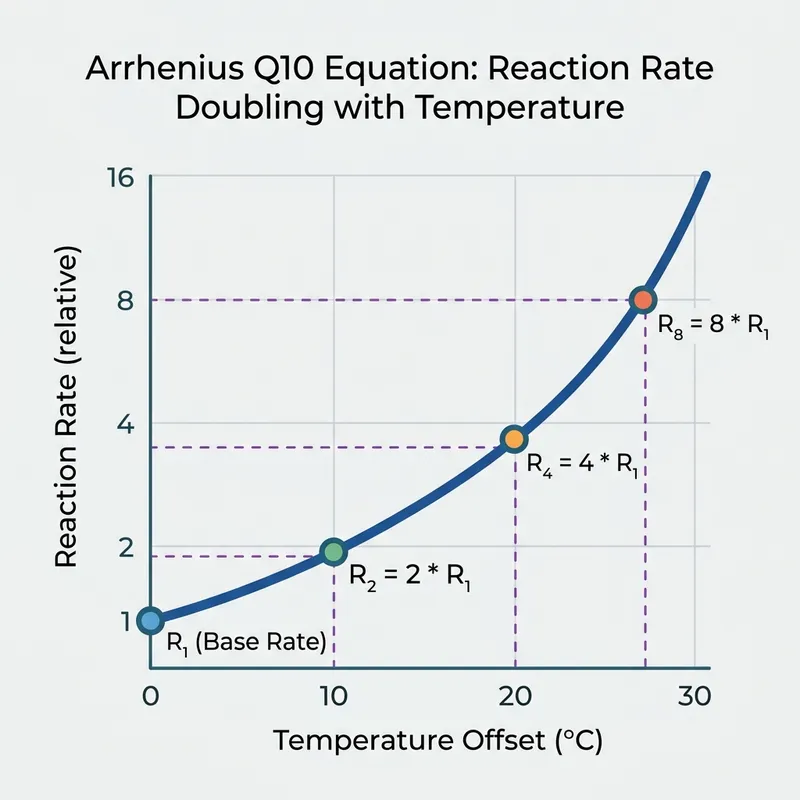
Choose a Q10 factor. The default Q10 of 2 means the reaction rate doubles for every 10°C increase. This is the most widely accepted value per ASTM F1980.

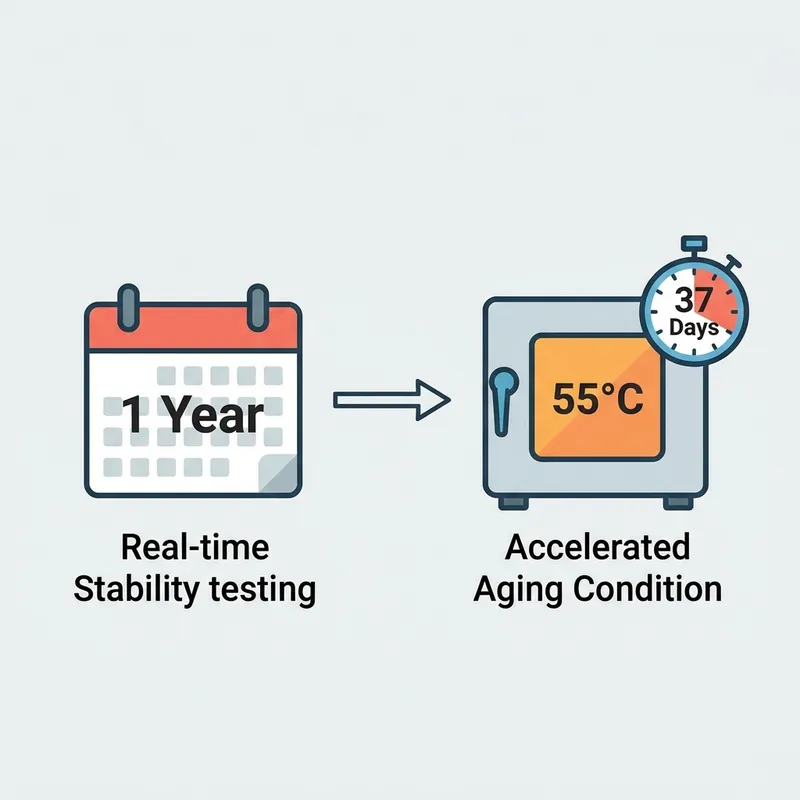
View results. The calculator shows the Accelerated Aging Factor (AAF) and the exact accelerated test duration required. For example, 1 year of real-time aging at 25°C might require only 42 days at 55°C with Q10 = 2.

The Science Behind Accelerated Aging

Accelerated aging is grounded in chemical kinetics:

Arrhenius Equation: The aging acceleration factor is calculated as AAF = Q10^((T_test - T_ambient) / 10). Higher temperature differences produce larger acceleration factors.

Q10 Factor: Represents the rate increase per 10°C temperature rise. A Q10 of 2 (most common) means each 10°C increase doubles the degradation rate. Conservative studies may use Q10 = 1.8.

ASTM F1980: This standard provides the accepted methodology for accelerated aging of sterile barrier systems. It recommends Q10 = 2 and test temperatures not exceeding 60°C.

Limitations: Accelerated aging assumes the Arrhenius model holds — meaning the degradation mechanism doesn't change at elevated temperatures. Materials that melt, phase-change, or degrade differently at high temperatures may produce misleading results.

Tips for Reliable Aging Studies

Ensure your accelerated aging study is valid:

  • Don't exceed 60°C — Per ASTM F1980, test temperatures above 60°C risk activating different degradation mechanisms, invalidating the Arrhenius assumption.
  • Always run real-time aging in parallel — Accelerated aging provides a claim with an asterisk. Real-time data is the gold standard for regulatory submissions.
  • Use Q10 = 2 unless justified — A Q10 of 2 is the industry standard. Using a higher Q10 without supporting data will be questioned by regulators.
  • Account for humidity — The standard Arrhenius model addresses temperature only. If your product is moisture-sensitive, consider environmental conditioning chambers.

Step-by-Step Instructions

  1. 1Open the Aging Test Calculator.
  2. 2Enter your target real-time shelf life (e.g., 2 years).
  3. 3Set the ambient (storage) temperature, typically 25°C.
  4. 4Set the accelerated test temperature (e.g., 55°C).
  5. 5View the acceleration factor and required test duration.

Aging Test Calculator — Frequently Asked Questions

What Q10 factor should I use?+

The industry standard per ASTM F1980 is Q10 = 2, meaning the degradation rate doubles for every 10°C increase. Use this unless you have material-specific data supporting a different value.

Can I claim shelf life based only on accelerated aging?+

You can make a conditional shelf life claim based on accelerated aging, but regulatory bodies (like the FDA) expect real-time aging data to support the final claim. Always run real-time aging studies in parallel.

Why shouldn't test temperature exceed 60°C?+

Above 60°C, many materials undergo structural changes (softening, phase transitions) that don't occur at normal storage temperatures. This violates the Arrhenius assumption and could produce unreliable results.

Share this tool: