How BMR and TDEE Work
Your body burns calories just to stay alive — breathing, circulating blood, growing cells. This baseline is your Basal Metabolic Rate (BMR). The most widely validated formula is the Mifflin-St Jeor equation, published in 2005 and recommended by the Academy of Nutrition and Dietetics as the most accurate for estimating resting metabolic rate.
The Mifflin-St Jeor Equation
For men: BMR = (10 × weight in kg) + (6.25 × height in cm) − (5 × age) + 5. For women: BMR = (10 × weight in kg) + (6.25 × height in cm) − (5 × age) − 161. A 2003 study in the Journal of the American Dietetic Association found that Mifflin-St Jeor predicted resting metabolic rate within 10% for 82% of participants — outperforming the older Harris-Benedict equation, which was accurate for only 69%.
From BMR to TDEE
Total Daily Energy Expenditure (TDEE) multiplies your BMR by an activity factor. The standard activity multipliers, developed by researchers at the Food and Agriculture Organization (FAO) and World Health Organization (WHO), range from 1.2 (sedentary) to 1.9 (extremely active). For example, a sedentary office worker with a BMR of 1,600 would have a TDEE of roughly 1,920 calories — while an active construction worker with the same BMR would need around 2,720.
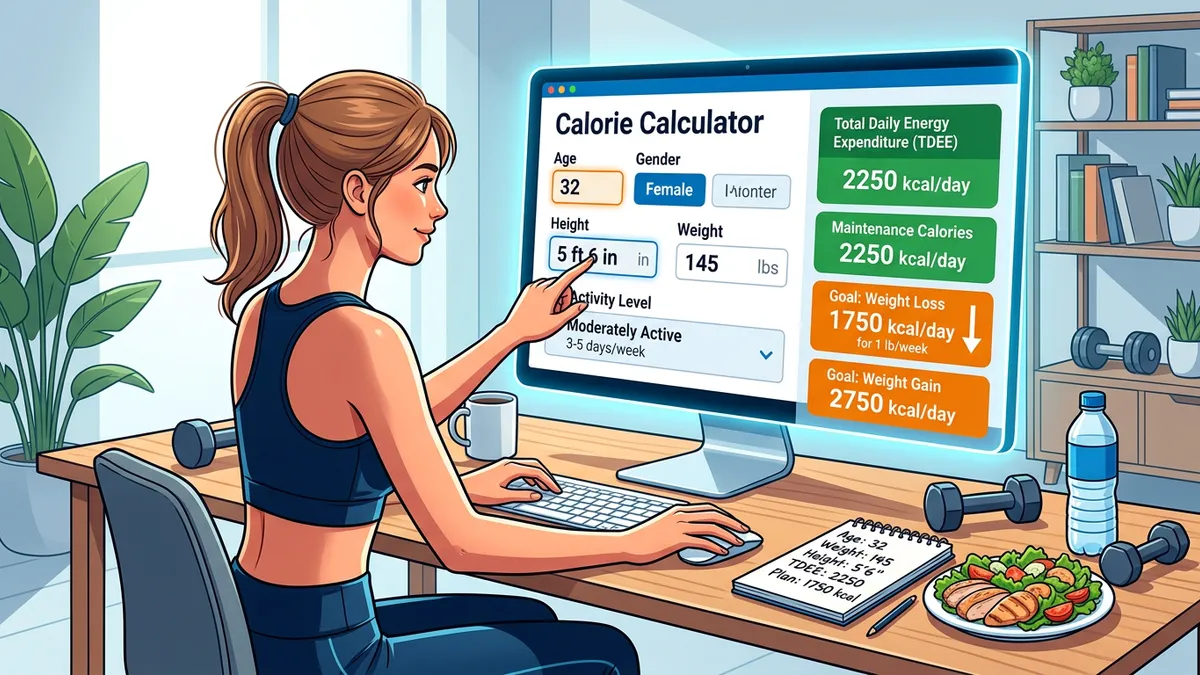
Calorie Deficit vs. Surplus for Weight Goals
How Weight Loss Works
To lose weight, you need to consume fewer calories than your TDEE — this creates a calorie deficit. The National Institutes of Health (NIH) estimates that a deficit of approximately 3,500 calories results in roughly one pound of weight loss. Registered dietitian Dr. Lisa Young, author of Finally Full, Finally Slim, recommends a moderate deficit of 500 calories per day for sustainable weight loss of about 1 pound per week.
How Muscle Gain Works
Building muscle requires a calorie surplus — typically 250–500 extra calories per day above your TDEE, combined with resistance training. Research published in the British Journal of Sports Medicine (2019) found that a surplus of 350–500 calories optimized lean mass gains while minimizing fat accumulation in trained individuals.
Safe Calorie Ranges
| Goal | Daily Adjustment | Weekly Change |
|---|---|---|
| Extreme loss | −1,000 cal | ~2 lbs/week |
| Moderate loss | −500 cal | ~1 lb/week |
| Mild loss | −250 cal | ~0.5 lb/week |
| Maintain | 0 | 0 |
| Mild gain | +250 cal | ~0.5 lb/week |
| Moderate gain | +500 cal | ~1 lb/week |
The American College of Sports Medicine (ACSM) advises against dropping below 1,200 calories per day for women or 1,500 for men without medical supervision, as very low calorie diets can lead to nutrient deficiencies, muscle loss, and metabolic slowdown.
Macronutrients: Protein, Carbs, and Fat
Why Macros Matter
Calories tell you how much to eat — macronutrients tell you what to eat. The three macronutrients are protein (4 calories per gram), carbohydrates (4 calories per gram), and fat (9 calories per gram). The Acceptable Macronutrient Distribution Ranges (AMDR), established by the Institute of Medicine, recommend 45–65% of calories from carbs, 20–35% from fat, and 10–35% from protein.
Protein for Weight Management
A 2015 meta-analysis in the American Journal of Clinical Nutrition found that higher protein intake (1.2–1.6 g per kg of body weight) improved satiety, reduced hunger, and preserved lean muscle mass during calorie restriction. Sports nutrition researcher Dr. Stuart Phillips of McMaster University recommends at least 1.6 g/kg for active individuals seeking body recomposition.
Common Macro Splits
| Goal | Protein | Carbs | Fat |
|---|---|---|---|
| General health | 30% | 40% | 30% |
| Weight loss | 35% | 35% | 30% |
| Muscle gain | 30% | 45% | 25% |
| Keto/low-carb | 25% | 5% | 70% |

Choosing the Right Activity Level
Activity Multiplier Guide
Selecting the correct activity level is the single most impactful variable in your TDEE calculation — choosing the wrong level can result in a 400–800 calorie miscalculation. The activity factors used in this calculator are based on the Harris-Benedict activity multipliers validated by the FAO/WHO/UNU joint expert consultation.
| Level | Multiplier | Description |
|---|---|---|
| Sedentary | 1.2 | Desk job, little to no exercise |
| Light | 1.375 | Light exercise 1–3 days/week |
| Moderate | 1.55 | Moderate exercise 3–5 days/week |
| Active | 1.725 | Hard exercise 6–7 days/week |
| Very Active | 1.9 | Physical job + daily training |
Common Mistakes
Research from the Journal of Sports Sciences (2018) found that people overestimate their activity level by an average of one tier. Most office workers should select "Sedentary" even if they exercise a few times per week. A better approach: choose the level that describes your typical day outside of dedicated workouts, then add exercise calories separately.
Special Considerations and Limitations
Age, Metabolism, and Adaptive Thermogenesis
BMR naturally declines with age — approximately 1–2% per decade after age 20, according to research in the American Journal of Clinical Nutrition. Additionally, when you consistently eat fewer calories, your body can reduce its metabolic rate through a process called adaptive thermogenesis. A landmark study by Dr. Kevin Hall at the NIH tracked contestants from The Biggest Loser and found their metabolisms had slowed by an average of 499 calories per day six years after the show — far beyond what weight loss alone would predict.
When Calorie Calculators Fall Short
All calorie calculators provide estimates, not exact values. Individual metabolic rates can vary by 10–15% even among people of the same age, sex, height, and weight. Factors like muscle mass, thyroid function, genetics, and gut microbiome composition all influence how your body processes energy. These calculators are best used as starting points — track your actual weight changes over 2–4 weeks and adjust your intake by 100–200 calories based on real-world results.
Step-by-Step Instructions
- 1Select your preferred unit system (metric or imperial).
- 2Enter your age, sex, height, and weight.
- 3Choose your daily activity level.
- 4Select your weight goal (lose, maintain, or gain).
- 5View your BMR, TDEE, and target calories.
- 6Check the macronutrient breakdown for protein, carbs, and fat.
- 7Review the meal distribution suggestion.